How it works, in pictures
The protocol page says what each contract does. This page shows the machine running: where the money from one trade goes, what happens to a launch in its first minutes, what a lot goes through, and what the treasury does in each kind of market. Who the people are, and what each one earns, is on who does what.
Rates are the factory's defaults as shipped (read on the deployed contracts, 2026-09-22): tax between 1% and 15% a side, 20% of the sell tax to the protocol, up to 30% to the creator, a 0.5% sweep tip and a 0.5% bounty, a sell spike of 90% decaying over 120 seconds, and a 99% buy window over 3 seconds. Every launch freezes its own copy at birth, so read that launch's live values before you trade. Prices in the examples are made up to make the arithmetic easy.
The whole machine
Four kinds of people, two contracts that hold money, and one place tokens go to die.

Read it as two loops. The trading loop (left): every buy burns a little of the token, every sell sends a little stock to the treasury. The treasury loop (right): stock is sold only above its own cost, the cost comes back as USDG to buy the next dip, and the gain buys the token back and burns it. A keeper is whoever sends the next call first; nobody is appointed.
Follow one trade's money
A sell of $1,000, at a 10% tax, with the creator on 30%
The tax is taken in the stock, so a $1,000 sell pays $100 worth of the stock, and the seller receives the rest.
A buy of $1,000, at the same tax
The buy tax is taken in the token, and burned.
So the two sides do different jobs: buys shrink the supply, sells fill the treasury. A token that only gets bought never funds its treasury; a token that only gets sold funds a treasury whose burns are then the only buyers.
The first minutes of a launch
The creator's own first buy is the one thing a buyer should check before anything else: it is exempt from the window, uncapped, and visible on chain. See what to check.
The life of a lot
A lot is a parcel of stock with the price it was booked at. Each lot runs this on its own:
Every sale splits the same way. Say a lot of 10 shares cost $100 and the price reaches $120:
| shares | where it goes | |
|---|---|---|
| half the lot is sold | 5 | — |
| … of which the principal (what it cost) | 4.17 sold for $500 | the USDG reserve, for the next dip |
| … of which the profit | 0.83, kept as stock | the buy-back: buys the token in its pool and burns it |
| the keeper's bounty | 0.5% of the profit | whoever sent takeProfit |
The profit is never turned into USDG. The token's pool is quoted in the stock, so the profit goes straight from stock into the token and into the fire.
One strategy, seven moves
A worked example. The strategy is the one CRCLGRID runs: take profit at +20% and +40%, buy a 15% dip with 20% of the reserve, no stop. The stock starts at $100, and 10 shares of sell tax have arrived.
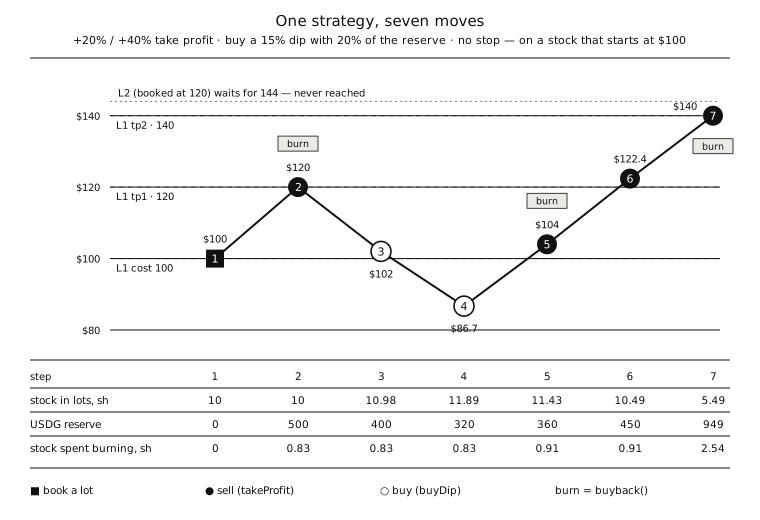
| # | stock | what fires | why | after it |
|---|---|---|---|---|
| 1 | $100 | book L1: 10 sh at $100 | sell tax arrived | the first lot also sets the dip reference at $100 |
| 2 | $120 | takeProfit L1, first half | 100 × 1.20 | $500 to the reserve; 0.83 sh of profit buys back and burns. More tax books L2: 5 sh at $120. Dip reference → $120 |
| 3 | $102 | buyDip → L3 | 120 × 0.85 | spends 20% of $500 = $100, buys 0.98 sh. Reference → $102 |
| 4 | $86.7 | buyDip → L4 | 102 × 0.85 | spends 20% of $400 = $80, buys 0.92 sh. L1's other half and L2 are under cost: no stop, so they wait |
| 5 | $104 | takeProfit L4, first half | 86.7 × 1.20 | the cheapest lot pays first: $40 back, 0.08 sh burned |
| 6 | $122.4 | takeProfit L3 first half, L4 rest | 102 × 1.20, 86.7 × 1.40 | reserve up to $450 |
| 7 | $140 | takeProfit L1, the rest | 100 × 1.40 | $500 back, 1.43 sh of profit — 1.63 sh burned with what was waiting |
Where it ends: 2.54 shares' worth of the token bought and burned (about $355 at $140), $949 of USDG ready for the next dip, and two lots still held — L3's second half waiting for $142.80, and L2, booked at the top, waiting for $144. Nothing sold below cost, and nothing was ever asked of a person: each step was sent by whoever wanted its 0.5%.
Measured against simply keeping the 15 shares: at $140 those are worth $2,100; the rule holds $1,717 and has burned $355 — about the same, with a sixth of it turned into a smaller supply. On a path that ends where it started, the rule is ahead; on a straight line up, holding the stock wins. That is the trade a take-profit strategy makes.
What happens in each kind of market

| market | the treasury | burns | the creator | a keeper | a holder |
|---|---|---|---|---|---|
| Chops in a range | sells every top, rebuys every dip, lots turn over | every swing | paid on every sell, as always | the busiest market to run | the best case: the rule was built for this |
| Grinds up | takes profit at each target; new tax books at ever-higher costs | steady | paid | steady work | burns, but the treasury holds less stock than if it had held |
| Falls and stays down | buys each 15% step with 20% of what is left; sells nothing | none | paid, if people still sell | only buyDip pays | no burn; lots wait for a recovery that may not come |
| Crash, then recovery | spends the reserve at the lows; the cheapest lots hit target first | a burst on the way back | paid | a burst of work | the dips pay out as burns |
| Flat | nothing triggers; new tax is booked, then waits | none | paid only from volume | nothing to send | nothing happens — holding earns nothing |
| Market closed (nights, weekends, holidays) | health() is false: no book, no sale, no dip | buy-backs continue, off the token pool's own price | paid — the token trades all week | buyback and sweep only | the token trades; the stock leg waits for the open |
| Feed stale, or a corporate action | the oracle fails closed; the stock leg pauses | buy-backs continue up to 5 days | paid | buyback only | as above |
| Heavy selling of the token | more tax arrives, more lots | the next buy-back spikes the sell rate | paid more | more to sweep and book | sellers pay the most right after a burn |
| No trading at all | nothing new arrives; what it holds still works its targets | only from existing profit | nothing | little | nothing is paid to anyone |
If it keeps falling
Each dip spends a fixed share of what is left, so the reserve shrinks geometrically and is never spent to zero in one move. With a 15% dip and a 20% lot:
| dip # | stock vs the last sale | this buy spends | spent so far |
|---|---|---|---|
| 1 | −15% | 20% of the reserve | 20% |
| 2 | −28% | 16% | 36% |
| 3 | −39% | 12.8% | 49% |
| 4 | −48% | 10.2% | 59% |
| 5 | −56% | 8.2% | 67% |
| 10 | −80% | 2.7% | 89% |
The buys get smaller as the price gets lower, and they stop when a buy would fall under the treasury's minimum lot. A treasury with no stop never sells into this: it waits, and it does not burn until something comes back above cost.
With a stop
A stop is the only way a lot sells below cost. It turns a waiting loss into a realised one: the proceeds return to the reserve as USDG, there is no profit, so nothing burns, and the keeper is paid from the proceeds. A stop never fires on a price only the pool vouches for — during a closure it waits for the open, because a fake weekend crash would otherwise lock in a loss that never happened.
Five numbers, four temperaments
The same stock, the same market, four different strategies. What each does is the table above, sharpened:
| Patient | Active | Range grid | Grid with a stop | |
|---|---|---|---|---|
| take profit | +100% / +250% | +8% / +18% | +20% / +40% | +20% / +40% |
| dip · lot | −12% · 5% | −5% · 20% | −15% · 20% | −15% · 20% |
| stop | none | none | none | −25% |
| chops in a range | rarely sells; almost no burns | sells and burns constantly | its home | its home |
| grinds up | sells late and big | sells out early, then only new tax | steady | steady |
| falls hard | waits, sips the reserve | spends the reserve quickly | waits, buys in steps | sells at −25%, burns nothing, rebuys lower |
| burns come | rarely, in large lumps | often, in small ones | once per swing | once per swing, none from a stop |
None of these is the right one. They are different bets on the same stock, published before anyone buys and frozen afterwards — which is exactly what lets a stranger choose between them.
What this picture does not show
- Holders have no claim on the treasury. No share, no NAV, no redemption. The only path from the treasury to a holder is the buy-back and burn.
- Burns are not a price floor. A smaller supply helps the price only if someone still wants the token.
- The keeper is not a guarantee. A call gets sent when its bounty is worth more than the gas; a tiny treasury may wait longer for its turn.
- The risks are listed in full on the protocol page.