How it works
A Hedgefun token is sold on a price curve for a tokenized stock. At 79.31% sold the token graduates into a locked trading pool, and a treasury receives 30% of the money raised. The treasury holds the stock, trades it by the rule the creator picked, and spends what it earns on buying the token back and burning it. The example is a $200 stock with a 3% tax and the creator on 10% of it.
Four characters appear in the pictures: the creator, the buyer, the treasury (the hedgehog) and the keeper (the robot that presses the buttons).
The life of a token
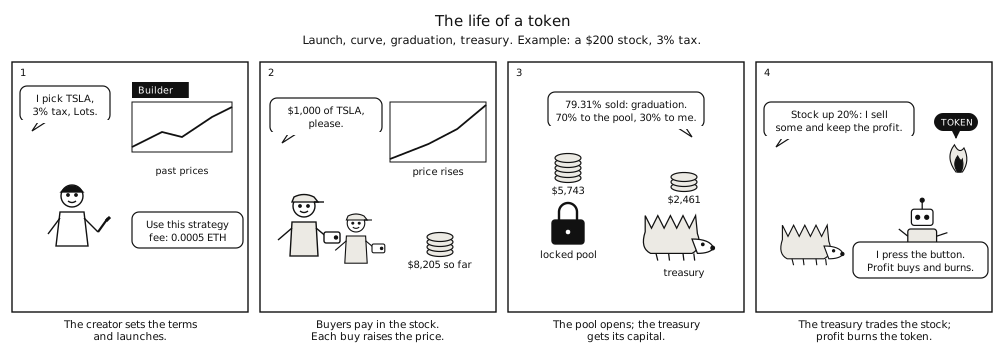
The curve starts empty. Every buy adds stock to it and raises the price. Every sell takes stock out and lowers the price. The buy that brings the total to $8,205 finishes the sale and opens the pool in the same moment. The curve has no deadline, and until it completes you can sell back to it at any time.
The opening price values all the tokens at $2,140. The price at graduation is about 23 times higher, which values them at about $50,000. In the opening window, the first 0 to 180 seconds, buyers pay a premium that starts at 99% and falls to the normal tax. The premium is burned from the buyer's tokens. The creator's own first buy skips it.
What you pay

| trade | tax | pool fee | on $1,000 |
|---|---|---|---|
| buy, on the curve or in the pool | 3%, in stock | 0.20% in the pool, in stock | $30, plus $2 after graduation |
| sell, on the curve or in the pool | 3%, in stock | 0.20% in the pool, in tokens | $30, plus about $2 of tokens burned |
| launch | 0.0005 ETH |
The tax goes 30% to the protocol, up to half to the creator and the rest to the treasury: on $30, that is $9, $3 and $18. 30% of the protocol's $9, about $2.70, buys $HEDGE back. The pool fee on a buy goes to the treasury's buy-back budget, separate from its strategy capital; the pool fee on a sell is burned. There is no extra charge after a buy-back.
Graduation

The pool's liquidity belongs to a vault with no withdraw function. Nobody, including the creator and the protocol, can take it out. Nothing is burned at graduation, and the price does not jump. The treasury's 30% is the only part of the raise that is ever spent, and only by the strategy. Early buyers who sell into the pool are selling into $5,743 of stock plus whatever later buyers add.
What the treasury does with its stock
Seven strategies, three families. The creator picks one at launch. Every family ends the same way: stock set aside for the buy-back buys the token in the pool and burns it. The stories use the $200 stock and a treasury that starts with $2,461 of it.
Lots, Percentage buy-back, Cycle and Lots with reserve

The creator chose Lots: sell half a lot at +5% and the rest at +10%, buy again after a 5% dip, no stop. The creator set a 3% tax and took 10% of it, so every $1,000 of trading pays the creator $3 in stock. The creator cannot change the rule after launch. Percentage buy-back is the same rule with smaller buy-backs; Lots with reserve first sells a share of the stock the creator picks, up to half, so it has cash for the very first dip; Cycle adds one more buy after a sale if the stock keeps rising.
The buyer sees "Lots" on the token page with those numbers, the treasury's $2,461 of stock, and whether the treasury can trade right now. A $1,000 buy costs $30 of tax. The buyer holds a token whose supply falls each time the treasury sells at a gain.
The treasury books its $2,461 as one lot at $200. When the stock rises 20% to $240, it has passed both targets: half the lot sold at $210 and the rest at $220, about $2,461 came back as cash and about $184 of profit stayed as stock for the buy-back. When the stock then falls 15% to $204, that is 7% under its last sale, so it spends 20% of its cash, $492, on a new lot at $204. If the stock keeps falling it waits; without a stop it never sells at a loss.
The keeper sends each sale and each buy and keeps 0.1% of what the action produced: about 6 cents on the first sale, 12 cents on the second, 49 cents on the dip buy. The protocol runs this keeper. Anyone may press the same buttons.
What gets burned: the $184 of profit buys the token in the pool and burns it, $500 at a time for Lots and a tenth of the jar at a time for Percentage buy-back and Cycle. Opening premiums and the token side of the pool fee burn too.
Buy-back

The creator chose Buy-back and no rule numbers; only the tax, 3%, and the creator's share, 10%.
The buyer sees "Buy-back", the $2,461 that never moves, and the jar of fees waiting to burn.
The treasury does not trade. When the stock rises 20%, its $2,461 is worth $2,953 and it does nothing. When the stock falls 15%, it is worth $2,092 and it does nothing. Every $1,000 trade sends it $18 of tax, and every $1,000 pool buy adds $2 of pool fee.
The keeper presses buy-back whenever the jar holds fees and 10 seconds have passed, and keeps 0.1% of the tokens bought.
What gets burned: every token the fees buy.
Spot and Rebalance

The creator chose Rebalance: hold 70% in stock and 30% in cash, act when the mix drifts 3 points, wait 10 minutes between actions, trade at most 10% of the holdings per action, and send 100% of each sale's gain to the buy-back. Spot is the same rule with the trade sizes in dollars.
The buyer sees "Rebalance 70%", the current mix, and the time of the last action.
The treasury starts 100% in stock, so its first actions sell 10% at a time until it holds about $1,723 of stock and $738 of cash. When the stock rises 20% the mix reaches 74%, so it sells about $104 of stock back to 70% and keeps the gain on that slice for the buy-back. When the stock falls 15% the mix reaches 66%, so it buys about $77 of stock back to 70%. A sale under its average cost has no gain and sends nothing to the burn.
The keeper presses the button once per cooldown when the mix is outside the band, and keeps 0.1% of the amount traded: about 10 cents on the $104 sale.
What gets burned: the gain over average cost on every sale, plus opening premiums and the token side of the pool fee.
What holders own and do not own
- You own tokens. Their supply only falls: opening premiums, buy-backs and sell-side pool fees are burned.
- What the treasury earns buys the token back and burns it. You have no claim on the treasury itself (none today; one may be added later). There is no redemption and no dividend.
- You cannot withdraw the pool's liquidity. Neither can the creator or the protocol.
- A burn is not a price floor. Fewer tokens help the price only if someone wants them.
- The owner can change a treasury's strategy logic after a two-day public notice. The locked pool is outside that power.
Related
- Questions first-time buyers ask
- Quick start: launching and buying, step by step.
- Who does what and the protocol, for every number.